 Customer portals
 Contact us

Renewable and readily available biogas offers security of supply where electricity fails
Biogas is a renewable fuel that offers security of supply and lower emissions even in extreme conditions and remote locations. This was further proven by Gasum as it began supplying liquefied biogas to Svalbard in Norway. Produced in line with circular economy, biogas can be a definite part of the future mix of energy sources that doesn’t rely on the capacity or regularity of the electric grid.
Gasum took a significant step in its operations in Norway as it started supplying liquefied biogas (LBG) to the airport in Longyearbyen, Svalbard. Located 1 000 kilometers north from Tromsø, the Svalbard Islands are by far the northernmost and remotest place Gasum has ever supplied biogas to.
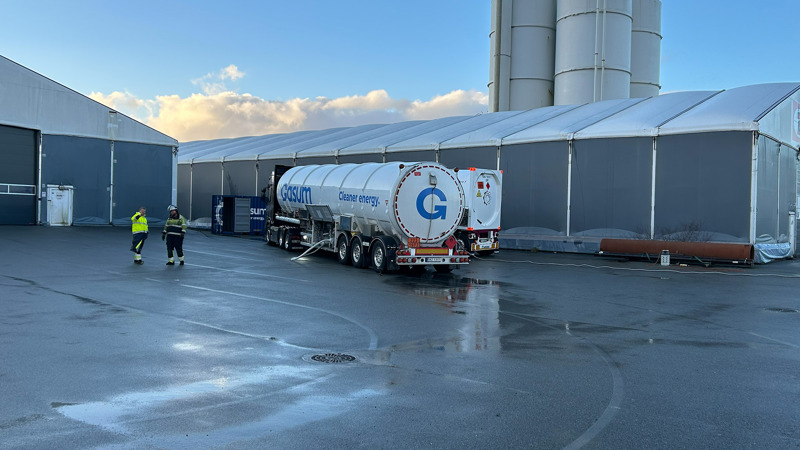
Gasum delivers LBG to Svalbard from Risavika, Norway. The containers are first shipped to Tromsø, from where they are shipped onwards to Longyearbyen. The operation demonstrates well that renewable fuels can be supplied reliably and safely, even when distances are long and local infrastructure is limited.
Svalbard is a good example of LBG’s advantages. As a readily available renewable fuel with significant emission reductions, LBG is a viable alternative for energy production also for use cases where, for example, renewable electricity is not an option, or the electricity grid is at capacity.
Biogas is a suitable fuel also for extreme conditions
Different industry sectors in Norway’s mainland rely heavily on electrification in their energy transition. However, with the rising number of datacenters asking for more electricity than total domestic production capacity, the country’s electricity grid is in high demand making it increasingly important to have complementary energy solutions. LBG is a perfect option for cases where electricity fails.

“To ensure our security of supply in the future, it is important that we have a mix of different energy sources to utilize instead of relying just on electricity. LBG is a definite part of that mix,” says Trond Jerve, Gasum Norway’s Head of Business in Industry.
Energy needs in Svalbard’s extreme conditions have historically been covered by coal, which was replaced with diesel in 2023. Due to Svalbard’s remote location, ensuring a reliable energy supply on the islands requires fuel-based solutions. For example, solar energy is difficult to implement as there are very few daylight hours in Svalbard during the winter season.
In practice, fuel-based solutions bring resilience: deliveries can be planned in advance, storage on site supports continuity, and energy production is not dependent on weather patterns or real-time grid availability. For critical operations such as airport services, heating and supporting infrastructure, having a reliable, storable fuel helps reduce the risk of interruptions.
The Svalbard Airport is operated by Norwegian state-owned Avinor that operates a total of 43 airports in Norway. Until now, it has represented 15–20% of Avinor’s total GHG emissions. Choosing biogas reduces the airport’s emissions significantly compared to traditional fossil fuels like diesel.
Gasum supplies Avinor its premium product LBG Plus, which has typically a negative Carbon Intensity (CI) score of -15 grams of CO2 eq/MJ. It is also certified in accordance with ISCC and provided with Proof of Sustainability (PoS) documentation.
Biogas is produced according to circular economy
The EU is aiming to build circular economy by 2050 to both mitigate climate change and limit the loss of biodiversity. Biogas is a prime example of how circular economy works. Simply put, its production process turns organic waste into valuable products that help mitigate the climate change and enhance circular economy. Biogas supplied by Gasum is produced using different types of organic waste, such as biowaste, organic waste from households, sewage sludge, manure and other industrial and agricultural side streams.
During the production process, the biodegradable feedstocks are digested into renewable biogas and recycled nutrients by anaerobic microbes that feed on the biomass. Capturing methane from the waste streams and upgrading it into biogas helps prevent emissions that would otherwise occur when the material decomposed uncontrolled. The remaining digestate can be utilized as a recycled fertilizer product, returning nutrients back to the soil and reducing the need for virgin, fossil-based fertilizers.
Gasum is one of the biggest biogas producers and suppliers in the Nordics. It controls the entire value chain of biogas from producing to end-deliveries making its position on the market unique. Gasum’s robust value chain also enhances biogas’ security of supply to customers.
Biogas can be carbon negative
As an energy source biogas has multiple use cases. It can be used as a fuel for heavy-duty vehicles and maritime transport, as well as in industry and energy production. Biogas works well also in extreme weather conditions, such as low temperatures typical in the Nordics.
“Biogas is the only fuel that can be carbon negative – as is the case with the biogas product we supply Avianor with. This proves that even a remote and isolated location, such as Svalbard, can utilize 100% renewable and carbon negative fuels for all energy needs without compromising their security of supply,” Jerve explains.
Gasum is dedicated to bringing increasingly more renewable gas to the Nordic market in the coming years to help its customers reach their emission reduction targets.
The Svalbard delivery illustrates how renewable gas can support both decarbonization and operational reliability. It enables meaningful life-cycle emission reductions while providing an energy source that can be stored, transported and used independently of grid constraints. As more regions face growing electricity demand, solutions like LBG can complement electrification and help ensure that the transition remains resilient.