 Customer portals
 Contact us

Gasum’s portfolio management helps shipping companies reduce EUA market risks
Rising EU Emissions Trading System (EU ETS) requirements push shipping companies to rethink how they manage emission allowances. Gasum’s Portfolio Services (GPS) helps shipping companies purchase and manage EU Emission Allowances (EUA) strategically, reducing cost volatility and providing cost predictability.
The EU ETS has rapidly become a major and volatile cost factor for maritime operators using fossil fuels. By 2026, shipping companies must offset 100% of their fossil-based emissions with EU Emission Allowances (EUA), up from 70% in 2025.
This requires companies to adopt quickly more strategic approaches to manage allowance purchases. To help maritime customers to maneuver in the unpredictable EUA market successfully, Gasum offers a dedicated portfolio management service for EUAs through Gasum Portfolio Services (GPS).
EUA prices have fluctuated strongly, moving between approximately 60 and 90 euros per tonne during the past year. For a mid‑sized operator, swings can translate into several million euros in yearly cost difference depending on when allowances are bought. The combination of rising coverage and price volatility makes reactive, ad-hoc buying increasingly risky.
Read more: EU ETS for maritime

Jani Arala, Commercial Manager, Maritime Sales at Gasum, notes that new compliance requirements have increased pressure on companies.
"We expanded the GPS service for the maritime sector earlier, but the urgency has now increased significantly among shipping companies. With one hundred percent coverage in place, companies cannot afford to treat ETS as an afterthought."
Contact us: FuelEUpooling@gasum.com
A structured portfolio approach brings predictability also for mid-sized companies
In addition to providing market access, Gasum’s Portfolio Services, GPS uses a strategic portfolio management method similar to its approach in gas and power. This includes ongoing monitoring and analysis of market and political trends, a well-defined procurement policy agreed with each customer, and consistent communication with customers. Allowances are bought in a controlled way that follows the procurement policy. This strategy helps reduce volatility and makes future costs more predictable.
Moreover, GPS is a licensed financial services provider in the energy sector. GPS offers market recommendations and advice without taking proprietary trading positions, making it valuable for companies needing decision support or lacking internal market expertise.
“GPS has been offering EUA services for the industrial sector since the EUA market was established in 2005. After the EU ETS expanded to the maritime sector, the biggest shipping companies have been hedging and managing their EUA exposure strategically. Our role is to bring that same capability to shipping companies who don’t have specialized teams of their own,” Taavi Leikola, GPS Portfolio Manager explains.
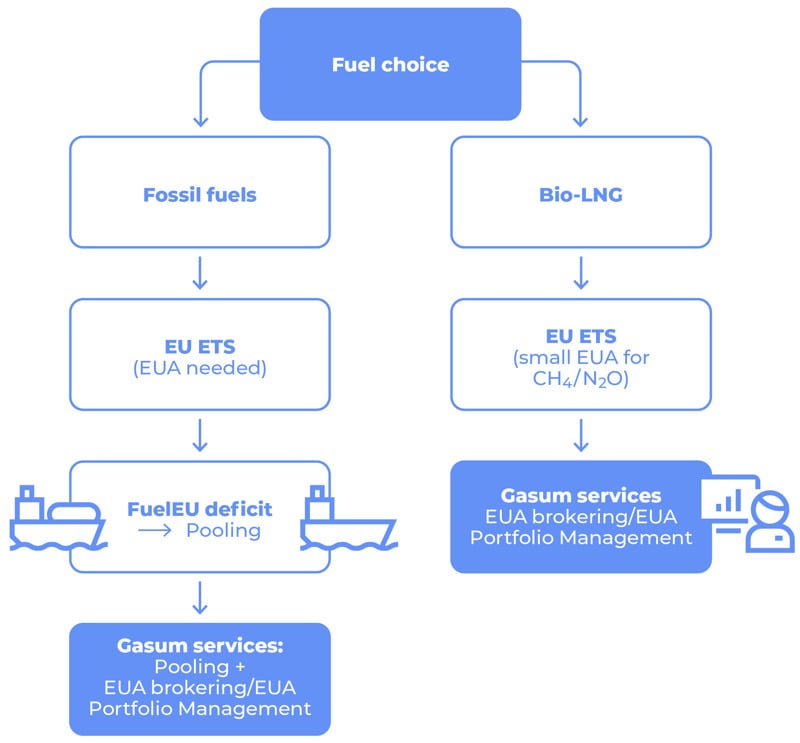
Fuel choice determines EU ETS and FuelEU compliance needs, supported by Gasum’s EUA portfolio management and pooling services.
Strengthening operational planning and budgeting
For many maritime operators, one of the biggest challenges under the EU ETS is integrating emission allowance management into day‑to‑day operational planning. Fuel choices, vessel deployment, speed optimisation and routing decisions all influence the company’s final compliance position.
Gasum Portfolio Services supports customers by modelling different operational scenarios and forecasting their associated EUA needs. This enables operators to compare the cost impacts of different strategies well in advance, rather than reacting once emissions are already realised.
“By connecting procurement policy, market intelligence and operational forecasting, we help our customers integrate EUA management directly into their commercial planning and budgeting processes. This approach makes ETS compliance an active, forward-thinking aspect of daily business operations, rather than just a mandatory administrative requirement,” Taavi Leikola says.
Helping maritime customers navigate a changing market
Gasum Portfolio Services offers clarity and complete portfolio management. While customers still report their emissions and oversee their Maritime Operator Holding Account, GPS handles the timing, execution, and strategic planning of allowance purchases. This approach helps shipping companies to better understand their EUA costs and enables companies to price voyages more accurately.
As ETS coverage expands and price volatility persists, managing EUAs strategically is key to staying competitive in shipping. The EU ETS impacts costs for companies using fossil fuels, making effective cost control crucial. Gasum's portfolio management service helps companies manage ETS exposure, improve cost predictability, and adapt to changing regulatory environment. Partnering with Gasum enables operators to handle rising expenses and lead in sustainable EUA procurement practices.
Jani Arala notes that the need for this service is stronger than ever. “Costs are rising and volatility is high, so operators recognise the need for smarter, more strategic allowance purchases,” he says.
FuelEU Maritime adds another layer of cost and complexity
In addition to the EU ETS, shipping companies now face FuelEU Maritime requirements, which gradually tighten greenhouse gas intensity limits for marine fuels. While the ETS imposes costs on fossil CO₂ emissions, FuelEU Maritime introduces extra operational costs by incentivizing a shift to lower-carbon energy sources. To help operators adapt, Gasum offers pooling services that allow companies to collaborate and aggregate compliance efforts.
For companies still using fossil fuels, regulations can raise voyage costs through compliance penalties, while operators adopting alternative fuels must manage price premiums and market availability. Emissions, fuel choice, vessel deployment, and routing affect both EUA needs and FuelEU Maritime compliance. Together with rising EUA coverage and market volatility, these overlapping regulations significantly increase the financial impact of daily operations.
Many operators are now integrating their ETS and FuelEU Maritime strategies, making procurement, fuel planning, and operational forecasting work together. For operators that continue to use fossil fuels, Gasum supports EU ETS compliance through strategic EUA purchasing and enables FuelEU Maritime compliance by providing pooling services.