 Customer portals
 Contact us

LNG as a marine fuel: what it is, where it stands, and why it matters in 2026
In 2026, LNG has stopped being a pilot fuel in shipping. Roughly 800 LNG-capable vessels are in service and another 600 are on order. Bunkering is available in 222 ports worldwide, supplied by 62 dedicated bunker vessels. At the same time, FuelEU Maritime and the EU Emissions Trading System have turned fuel choice into a compliance question, not just an operational one.
For shipowners and charterers weighing fuel options, the honest 2026 read is this: LNG is a mature fuel with real near-term compliance value, and its long-term value depends on methane-slip control and the shift to bio-LNG and e-methane.
Where LNG stands in 2026
The LNG-fueled fleet is no longer experimental. DNV's 2025 orderbook data show LNG representing 58% of alternative-fuel container tonnage contracted in 2025. SEA-LNG's 2026 infrastructure review counts 222 ports with bunkering availability and 38 additional bunker vessels on order.
Three clusters carry most of the activity:
- Northwest Europe and the Baltic. Rotterdam bunkered more than one million cubic meters of LNG for the first time in 2025, including 17,644 m³ of bio-LNG.
- Western Mediterranean. Barcelona supplied 236,946 m³ across 547 operations in 2025, driven by ferry and cruise demand.
- Singapore–China axis for deep-sea liner shipping. Singapore delivered 571,400 mt of LNG bunkers in 2025. Shanghai reached 712,000 m³ of bonded LNG bunkering, up 54% year on year.
Adoption is led by deep-sea container lines, ferries, ro-pax, cruise, and selected tanker segments. MSC, CMA CGM, Maersk, and Hapag-Lloyd all operate significant LNG-pathway tonnage.
Environmental performance: clear on air, honest on climate
Air pollutants: a strong case
On local and regional air pollutants, LNG performs well. Sulfur oxides are essentially eliminated. Particulate matter and black carbon are sharply reduced compared with other fuels, and even distillates. NOx reductions vary by engine architecture but can reach an 85% reduction against conventional engines.
Black carbon is the least controversial climate-relevant advantage. A 2025 ICCT Arctic assessment found that LNG-fueled vessels accounted for 31% of CO₂ emissions but only 2% of black carbon emissions from EU-regulated ships operating in the Geographic Arctic. That is a significant difference in climate pollutants near ice and snow.
Climate: it depends on methane
Tank-to-wake CO₂ from LNG combustion is lower than for HFO or MGO because methane carries less carbon per unit of energy. Lifecycle greenhouse gas results, however, depend on engine type and methane slip. ICCT shipping factors show a wide spread: about 5.5 gCH₄/kWh for medium-speed low-pressure Otto engines, 2.5 gCH₄/kWh for slow-speed Otto engines, and 0.2 gCH₄/kWh for high-pressure diesel dual-fuel engines.
That spread explains why independent studies and industry assessments reach different conclusions. The honest summary: LNG is a proven fuel, lower on air-pollutants than traditional fuels, whose climate value depends on engine choice, methane-slip control, and the pathway to bio-LNG and e-methane.
How LNG fits EU rules: FuelEU and ETS
Two EU frameworks now govern the emissions picture for ships calling at EEA ports.
FuelEU Maritime applies from 1 January 2025 to ships above 5,000 GT. It sets a well-to-wake GHG intensity standard covering 100% of energy used on intra-EEA voyages, 50% on voyages into or out of the EEA, and 100% at berth. The 2025 target is 2% below a baseline of 91.16 gCO₂e/MJ, tightening to 6% in 2030 and 80% by 2050. Ships that beat the target generate surplus compliance units, which can be banked, borrowed, or pooled across fleets.
The EU ETS has applied to maritime since 1 January 2024. CO₂ is counted from 2024; CH₄ and N₂O enter the scope from 2026. Allowance ramps from 40% of 2024 emissions to 70% of 2025 emissions and 100% from 2026 onward.
LNG sits favorably under both. Lower direct CO₂ reduces the number of allowances needed under ETS. Under FuelEU, low-slip LNG vessels can run below the intensity target in the early years and generate tradeable surplus. CE Delft's FuelEU analysis shows that fossil LNG in a low-slip slow-speed dual-fuel engine can meet the 2025 and 2030 targets without renewable blending. From 2026 onward, methane slip becomes a direct cost lever in both systems at once, which is why slip measurement is now the highest-ROI compliance action most LNG operators can take.
The deeper mechanics are covered in The Double Dividend and the FuelEU Maritime practical roadmap.
Bio-LNG and e-methane: the fuel system matters more than the molecule
The strategic argument for LNG is the fuel system, not the molecule. Dual-fuel LNG engines and cryogenic tanks run on bio-LNG and synthetic e-methane without hardware changes. The same infrastructure, bunkering chain, and crew competences apply.
Under the EU's well-to-wake methodology, bio-LNG reaches very low lifecycle intensity, and with RED II manure credits it can even go negative. One vessel running on bio-LNG can generate enough FuelEU surplus to cover several conventional ships in the same pool. Gasum's cooperation with Viking Line and Wallenius SOL demonstrates the model: bio-LNG-fuelled vessels act as compliance generators, and other operators take the surplus as off-takers.
The same pathway is already visible in concrete bunker operations, with Gasum’s core bunkering activity concentrated in the Danish Straits and German ports, which are increasingly serving as alternatives to traditional hubs such as Antwerp and Zeebrugge.
An LNG-capable vessel ordered today is a bet on a fuel system, not on fossil gas.
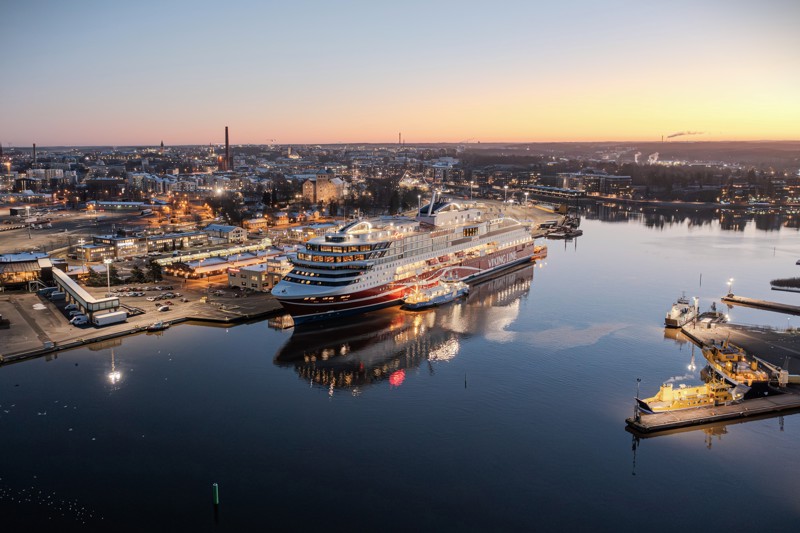
Gasum's cooperation with Viking Line demonstrates the model: bio-LNG-fuelled vessels act as compliance generators, and other operators take the surplus as off-takers.
Where LNG is being adopted
The clearest read on where LNG works commercially comes from the orderbook. DNV's 2025 data show LNG at 58% of alternative-fuel container tonnage contracted that year, with adoption concentrated in deep-sea container, ferry, ro-pax, cruise, and selected tanker segments. These are the segments with high annual fuel burn and predictable bunkering access.
LNG retrofits are major capital projects, not bolt-ons. A widely cited SEA-LNG study put turnkey VLCC LNG retrofit CAPEX at about $30.3 million. Operating economics are mixed in the other direction: LNG avoids scrubbers, meets sulfur rules by default, and lowers ETS allowance demand, while adding cryogenic system maintenance and boil-off management.
Fuel prices and the carbon price now sit in the same conversation. At EUA prices around €75, buying the allowances to cover the emissions from one ton of VLSFO or MGO costs roughly $280 on top of the fuel itself. For much of 2025 and 2026, LNG bunker prices have tracked in a similar band to distillates, which is one reason LNG remains on the shortlist for Europe-exposed fleets.
How Gasum fits in
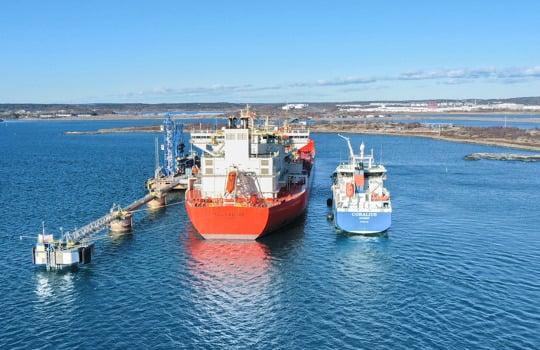
Gasum operates the largest LNG and bio-LNG bunkering network in the Nordic and ARA region, with more than 1,000 completed bunkering operations through its dedicated vessels Coralius and Kairos, and LNG terminals in Finland, Sweden, and Norway. The same network supplies bio-LNG through the same bunkering infrastructure.
For shipowners focused on FuelEU compliance rather than fleet conversion, Gasum's maritime pooling service offers a commercial route. Vessels operated by Viking Line and Wallenius SOL, together with Gasum's own bio-LNG-fueled fleet, generate compliance surplus that off-takers can purchase without modifying their ships or fuel plans.
For a closer look at operations, see how LNG bunkering works. For the compliance strategy behind pooling, see the FuelEU Maritime roadmap.
Gasum offers LNG and bio-LNG supply, as well as FuelEU pooling services for shipowners operating in Europe. To discuss compliance options and operational setup for your fleet, contact Gasum’s maritime team.