 Customer portals
 Contact us

What is LNG bunkering? A complete guide
LNG bunkering is the process of supplying liquefied natural gas (LNG) to ships for use as marine fuel. This guide covers delivery methods, operational procedures, safety requirements, and where bunkering infrastructure is available.
What is bunkering?
Bunkering is the process of supplying fuel to ships. LNG bunkering applies this to liquefied natural gas - a cryogenic fuel stored at -162°C that requires specialized handling equipment and safety protocols.
The bunkering process involves several parties: the ship operator (customer), bunker supplier, terminal operator, port authority, and classification societies that certify safety compliance.
Read more: LNG and bio-LNG as competitive marine fuel alternatives
LNG bunkering delivery methods
LNG reaches ships through three methods. The choice depends on vessel size, port infrastructure, and volume requirements.
Ship-to-ship (STS) bunkering
A dedicated LNG bunker vessel moors alongside the receiving ship - at berth, anchorage, or during cargo operations. This is the most common method for large vessels like container ships, cruise ships, and tankers.
Bunker vessels typically carry 5,000-20,000 cubic meters and transfer at 60-1,250 cubic meters per hour. Over 62 LNG bunker vessels operate globally, with more on order.
In the Baltic and North Sea, Gasum operates several bunkering vessels:
- Coralius (5,800 m³) - Europe's first purpose-built LNG bunker vessel
- Kairos (7,500 m³) - DP2 certified with Ice Class 1A, 30-meter crane reach to bunker large container ships and cruise liners from alongside
- Seagas (160 m³) - delivers 60-70 tons daily to Viking Line cruise ships in Turku/Åbo
- Coral Energy – used for bunkering larger vessels and luxury cruise ships, expanding the capability and strength of the Gasum bunkering portfolio.
- Celsius (arriving 2027) - next-generation bunker vessel with enhanced efficiency
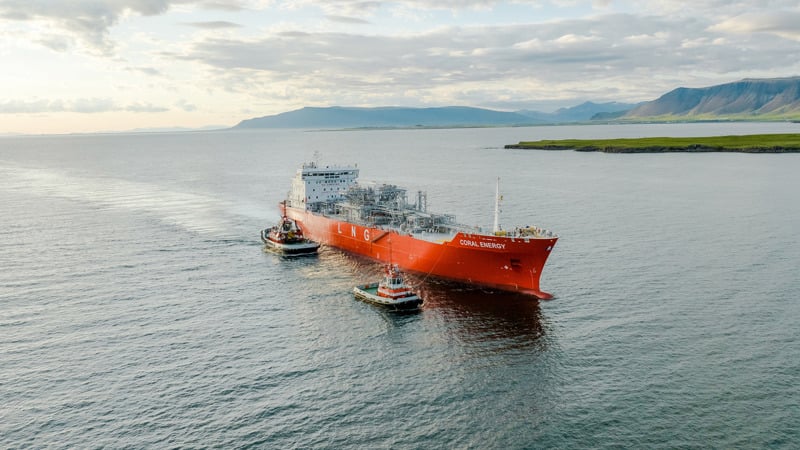
Coral Energy is used for bunkering larger vessels and luxury cruise ships
Truck-to-ship (TTS) bunkering
Specialized cryogenic road tankers deliver LNG directly at the quayside. Each truck carries 40-80 cubic meters (approximately 20 metric tons). Multiple trucks can operate simultaneously for larger volumes.
TTS suits smaller vessels, ferries, and ports developing LNG infrastructure. It offers flexibility - bunkering can occur at almost any quay with road access.
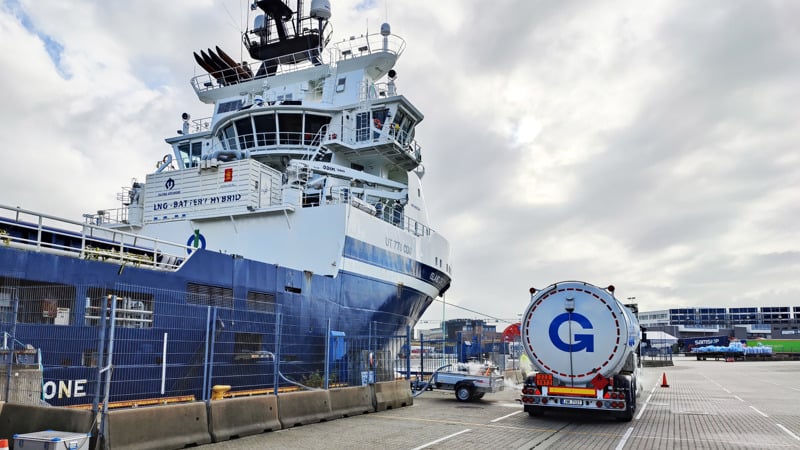
Flexible truck-to-ship LNG bunkering enabling supply at ports without fixed infrastructure.
Terminal-to-ship bunkering
LNG transfers from fixed onshore storage tanks to vessels via pipelines or loading arms. This ‘terminal‑to‑ship’ method provides high transfer rates and is used where dedicated LNG terminal infrastructure exists. Gasum performs the majority of its terminal‑to‑ship bunkering at the Risavika LNG terminal, which supplies vessels such as Fjord Line ferries.
The LNG bunkering process
A typical bunkering operation takes 4-12 hours depending on volume. Strict procedures govern each phase to manage LNG's cryogenic properties.
Before transfer
Ship and supplier representatives hold a pre-bunkering meeting to review quantities, flow rates, and safety procedures. Crews complete checklists, verify tank capacity (ullage), inspect transfer equipment, and test Emergency Shutdown (ESD) systems on both vessels. A safety zone is established around the bunkering manifold.
During transfer
Transfer begins at a slow rate to verify proper flow and check for leaks, then increases to the agreed rate. Crews continuously monitor pressures, temperatures, and tank levels.
Because LNG is stored at -162°C, heat causes some liquid to evaporate as boil-off gas (BOG). During bunkering, this displaced vapor returns to the supply vessel via vapor return lines, maintaining safe tank pressures.
After transfer
Flow rate reduces for final topping-off. Crews take final measurements, drain and purge lines with nitrogen, disconnect using dry-break couplings (which seal automatically to prevent spillage), and complete the Bunker Delivery Note documenting quantity and quality.
Simultaneous operations (SIMOPS)
Ships can often bunker LNG while conducting cargo operations or embarking passengers. These SIMOPS require additional safety measures but allow refueling without extending port stays - bunkering runs alongside normal operations rather than adding hours to the schedule. The ferry Viking Grace, for example, receives daily LNG bunkering in Stockholm while passengers board.
LNG bunkering safety
LNG bunkering has an established safety record - Gasum's vessel Coralius alone has completed over 1,000 operations without incident.
Key hazards include cryogenic burns from -162°C liquid, flammability when vapor mixes with air (5-15% concentration), asphyxiation in confined spaces, and tank overpressurization from BOG buildup.
Mitigation measures include:
- Safety zones excluding ignition sources around the transfer area
- ESD systems linking both vessels - automatic shutdown on leak detection, overpressure, or loss of communication
- Continuous gas detection monitoring
- Cryogenic PPE (gloves, face shields, flame-resistant clothing)
- Trained, certified personnel
- Emergency response procedures with regular drills
LNG bunkering regulations and standards
Two key frameworks govern LNG bunkering globally.
IGF Code (International Code of Safety for Ships using Gases or Low-flashpoint Fuels): The mandatory IMO standard for LNG-fueled vessels, covering ship design, double-walled fuel piping, gas detection, and crew training.
ISO 20519: The international specification for LNG bunkering operations - defining equipment requirements, procedures, personnel qualifications, and documentation including the Bunker Delivery Note.
Classification societies (DNV, Lloyd's Register, ABS, Bureau Veritas) publish technical guidance, and individual ports impose local permit requirements.
LNG bunkering infrastructure
LNG bunkering is available at approximately 200 ports worldwide, with 80+ additional ports building infrastructure.
Major hubs: Rotterdam, Singapore, Gibraltar, Barcelona, Zeebrugge, Jacksonville
Nordic and Baltic region
The Baltic Sea and North Sea - both Emission Control Areas - established LNG bunkering infrastructure earlier than most regions.
Key ports: Stockholm, Gothenburg, Helsinki, Turku, Oslo, Rotterdam
Gasum's ice-class vessels operate year-round, including through Baltic winters.
Bio-LNG bunkering
The same tanks, transfer equipment, and procedures used for LNG work with bio-LNG (liquefied biomethane from organic waste) and synthetic e-methane - no modifications required.
In 2025, the Finnish ferry Aurora Botnia became the first vessel to operate a carbon-neutral route, running on 100% bio-LNG supplied through existing bunkering infrastructure.
Conclusion
LNG bunkering is available at approximately 200 ports worldwide through ship-to-ship, truck-to-ship, and shore-to-ship delivery. International standards (IGF Code, ISO 20519) govern operations, and the same infrastructure handles bio-LNG without modification.
For vessels operating in the Baltic and North Sea, Gasum provides LNG and bio-LNG bunkering through its fleet of dedicated vessels and terminal network.
Looking for reliable LNG or bio-LNG bunkering?
Our Bunker Desk is here to support your operations across the Nordics and Europe.